 |
Property Makler
Advanced analytics for residential real estate investing |
|
Dubai, UAE US |
Dubai US Market Research
Dubai apartments investment market, May 2024 - unsynchronized changes in sales prices and rents create pockets of opportunities in cap rates
08 Jun 2024
Overview of Market Dynamics
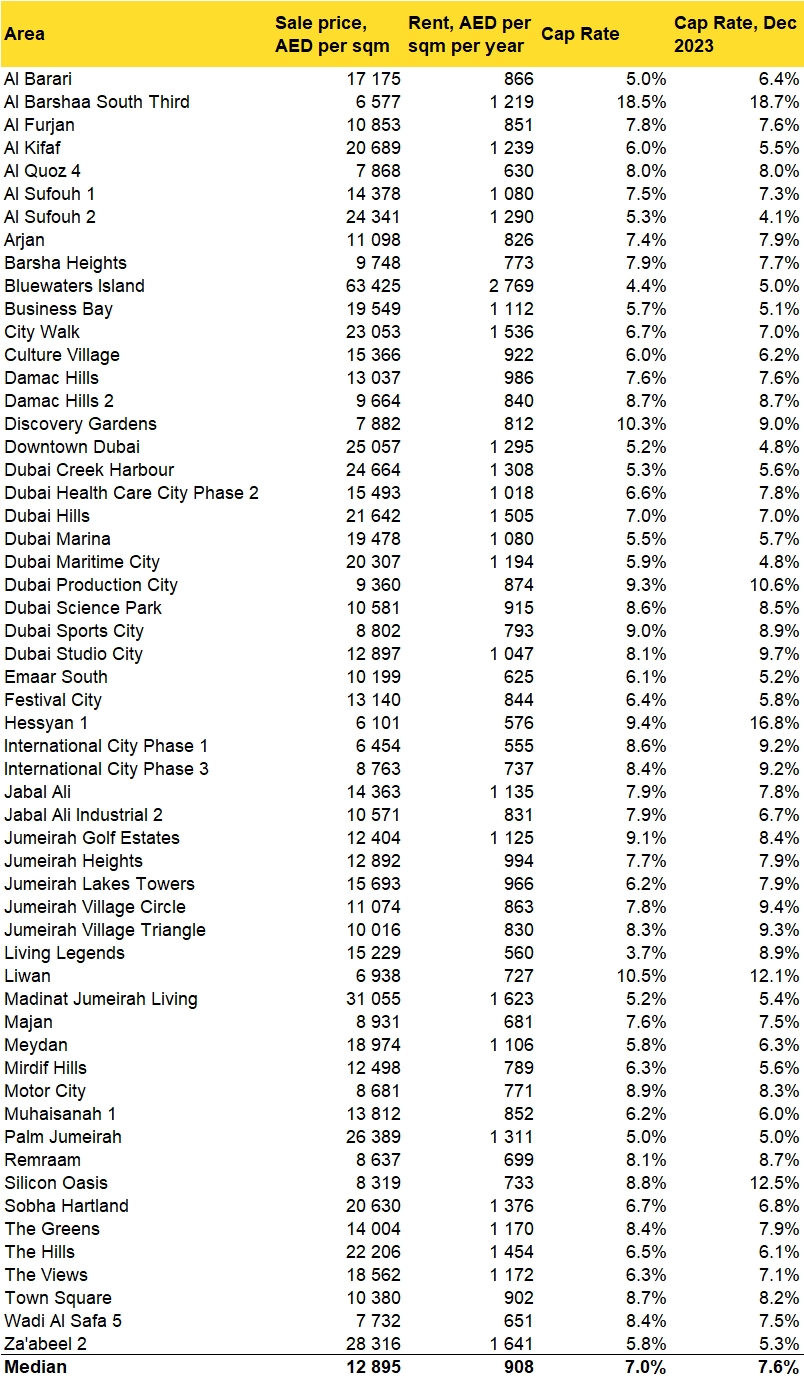
As of May 2024, the Dubai residential apartments investment market showcases a complex landscape marked by varying cap rates, sale prices, and rental yields across different neighborhoods. This market reflects the ongoing economic recovery, infrastructural developments, and changing tenant preferences. The median cap rate across Dubai is at 7.0%, a slight decrease from 7.6% in December 2023, suggesting stable investment returns with some regional variations.As prices and rents continued to grow in many areas in an unsynchronized ways, cap rates at some areas and projects raised above market level in surrounding areas or comparable locations which presents opportunities for investors.
Cap Rate Analysis
The cap rates, indicating the ratio of rental income to property value, vary widely across Dubai. Al Barshaa South Third stands out with the highest cap rate of 18.5%, slightly down from 18.7% in December 2023, indicating highly favorable rental yields relative to its property prices. Similarly, areas like Discovery Gardens and Liwan also offer high cap rates of 10.3% and 10.5% respectively. These high cap rates are driven by relatively lower property prices (AED 7,882 and AED 6,938 per sqm) combined with strong rental demand, making them attractive for investors seeking high returns.Conversely, luxury areas such as Bluewaters Island and Palm Jumeirah exhibit lower cap rates of 4.4% and 5.0% respectively, reflecting their high property values (AED 63,425 and AED 26,389 per sqm) and steady but lower rental yields. These areas, despite their lower cap rates, remain desirable for long-term investment due to their prestige and potential for value appreciation.
Changes in Cap Rates: May 2024 vs. December 2023
A comparison of cap rates from December 2023 to May 2024 reveals notable shifts. For instance, the cap rate in Hessyan 1 experienced a significant decrease from 16.8% to 9.4%, indicating fluctuations in property value on a low number of deals. Similarly, Silicon Oasis saw a reduction from 12.5% to 8.8%, which is attributed to sales of more expensive projects. On the other hand, areas such as Al Barari and Bluewaters Island saw a decrease in cap rates from 6.4% to 5.0% and from 5.0% to 4.4%, respectively. This could suggest rental yields catching up with property values, reflecting a more balanced investment environment.Sales Price and Rental Yield Insights
Sales prices per square meter across Dubai also show significant variation. Bluewaters Island leads with the highest property price at AED 63,425 per sqm, driven by its luxury status and prime location. Meanwhile, more affordable options can be found in areas like International City Phase 1 and Hessyan 1, with prices at AED 6,454 and AED 6,101 per sqm, respectively. Rental yields in these areas mirror their desirability and investment potential, with International City Phase 1 offering a cap rate of 8.6%, balancing affordability with attractive rental returns.Macro Drivers Behind Changes in Dubai Residential Apartments Investment Market
The changes observed in the Dubai residential apartments investment market as of May 2024 are influenced by several macroeconomic and socio-political factors. These drivers collectively shape the dynamics of property values, rental yields, and investment returns. Here are some key macro drivers:1. Economic Recovery and Growth
Post-Pandemic Recovery: The global economic recovery following the COVID-19 pandemic has significantly impacted the Dubai real estate market. Increased economic activity, higher employment rates, and improved consumer confidence have boosted demand for residential properties.Diversification Efforts: Dubai's ongoing efforts to diversify its economy beyond oil, focusing on sectors such as tourism, finance, technology, and logistics, have contributed to sustained economic growth. This diversification has attracted a diverse pool of expatriates and investors, increasing demand for housing.
2. Population Growth and Urbanization
Population Increase: Dubai's population continues to grow, driven by both natural growth and immigration. The city’s appeal as a global business hub attracts professionals from around the world, thereby increasing the demand for residential properties. Urban Development: Significant investments in infrastructure, including transportation, healthcare, and education, have made various areas in Dubai more attractive for residents. The development of new residential communities and the expansion of existing ones cater to the growing population.3. Government Policies and Regulations
Investor-Friendly Policies: Dubai's government has implemented several policies to attract foreign investment, including long-term visas for investors and property owners. These policies have enhanced investor confidence and contributed to higher demand for residential properties. Regulatory Framework: A robust regulatory framework ensures transparency and stability in the real estate market. Measures such as the introduction of escrow accounts and regulatory oversight by the Real Estate Regulatory Agency (RERA) protect investors and promote market stability.4. Infrastructure and Connectivity
Infrastructure Projects: Major infrastructure projects, including the expansion of the metro network, construction of new roads, and development of smart city initiatives, have enhanced connectivity and livability in various areas. Improved infrastructure boosts property values and rental yields.Expo 2020 Legacy: The successful hosting of Expo 2020 has left a lasting legacy, including enhanced infrastructure and global recognition. The areas around the Expo site, such as Dubai South, have seen increased interest from investors and residents.
5. Geopolitical Stability
Regional Stability: Relative geopolitical stability in the UAE and the wider region has bolstered investor confidence. Dubai is perceived as a safe and secure place to live and invest, attracting capital from around the world.International Relations: Strong diplomatic ties and trade relations with key global economies, including the US, China, and Europe, have positively impacted the real estate market. Favorable trade agreements and bilateral relations promote economic growth and investment.
6. Interest Rates and Financing
Low Interest Rates: Global monetary policies, particularly in response to the pandemic, have kept interest rates low. Affordable financing options make property investment more attractive, increasing demand and driving up prices.Access to Credit: Enhanced access to mortgage financing and favorable lending conditions provided by local banks support property purchases, particularly among first-time buyers and expatriates.
7. Technological Advancements
Smart Cities: The adoption of smart city technologies and innovations in property development enhance the appeal of residential areas. Features such as smart home technologies, energy-efficient buildings, and advanced security systems attract tech-savvy residents and investors. PropTech: The rise of property technology (PropTech) has streamlined property transactions, improved market transparency, and provided better data analytics for investors. Digital platforms facilitate easier property searches, transactions, and management.8. Tourism and Hospitality Sector
Tourism Growth: Dubai's thriving tourism sector continues to attract visitors and expatriates, supporting the rental market. Short-term rentals and serviced apartments benefit from high tourist inflows, particularly in prime areas like Downtown Dubai and Palm Jumeirah. Event Hosting: Hosting major international events and conferences boosts the city's global profile and attracts temporary residents, further supporting demand for rental properties. For investors, these trends highlight the importance of thorough market analysis and strategic decision-making. High cap rates in areas like Discovery Gardens and Liwan indicate strong investment potential, albeit with varying levels of risk and unpredictable liquidity for those investors who decide to exit. Conversely, luxury areas with lower cap rates provide stable but lower returns, suitable for investors seeking long-term value preservation.Dubai is competing with global cities for residential real estate investors
Dubai faces competition from several global cities when it comes to attracting real estate investors. Some of the prominent cities competing with Dubai include:- London, United Kingdom: London remains a major global hub for real estate investment, particularly in prime residential and commercial sectors. Its status as a financial center, cultural capital, and global city makes it a strong competitor to Dubai.
- New York City, USA: New York City is a magnet for real estate investment, especially in luxury residential properties and prime commercial real estate such as Manhattan. It offers unparalleled opportunities in finance, technology, and media sectors.
- Singapore: Singapore is a key competitor to Dubai in Asia, known for its stable economy, advanced infrastructure, and favorable business environment. It attracts investors seeking transparency, efficiency, and strategic location in Southeast Asia.
- Hong Kong: Hong Kong's real estate market is highly competitive, driven by its status as a global financial hub and gateway to China. It attracts investors looking for high-end residential and commercial properties, often serving as a bridge between East and West.
- Shanghai, China: Shanghai is a rapidly growing city and a major financial center in Asia. Its real estate market offers diverse investment opportunities, particularly in luxury residential developments and commercial properties.
- Tokyo, Japan: Tokyo's real estate market is characterized by stability, innovation, and high demand for luxury living spaces. It competes with Dubai in attracting global investors interested in Asia-Pacific markets.
- Paris, France: Paris is renowned for its historic charm, cultural attractions, and high-quality real estate offerings. It remains a desirable destination for international investors seeking luxury properties and stable rental yields.
- Sydney, Australia: Sydney's real estate market attracts investors due to its high quality of life, strong economy, and demand for premium residential and commercial properties. It competes with Dubai as a global destination for lifestyle and investment opportunities.
- Miami, USA: Miami is known for its luxury real estate market, attracting investors from around the world, particularly from Latin America and Europe. It offers waterfront properties, favorable tax environment, and vibrant lifestyle.
- Toronto, Canada: Toronto's real estate market is robust, driven by its status as a major financial center in North America. It competes with Dubai in offering diverse investment opportunities, stability, and economic growth prospects.
In conclusion, the Dubai residential apartments investment market in May 2024 presents a dynamic and varied landscape. Investors must consider a range of factors, including cap rates, sale prices, rental yields, and market drivers, to make informed decisions and capitalize on opportunities in this evolving market. The slight decrease in the overall median cap rate from 7.6% to 7.0% suggests a market that is stabilizing but still offers lucrative opportunities for astute investors.
Note: YTD is year to date (January – May 2024)
Tags: Investors
Property Makler © 2026 Contacts T&C About